
Portal Cavalus
How GritoWeb looks after Brazil's biggest equestrian portal, from code to server.
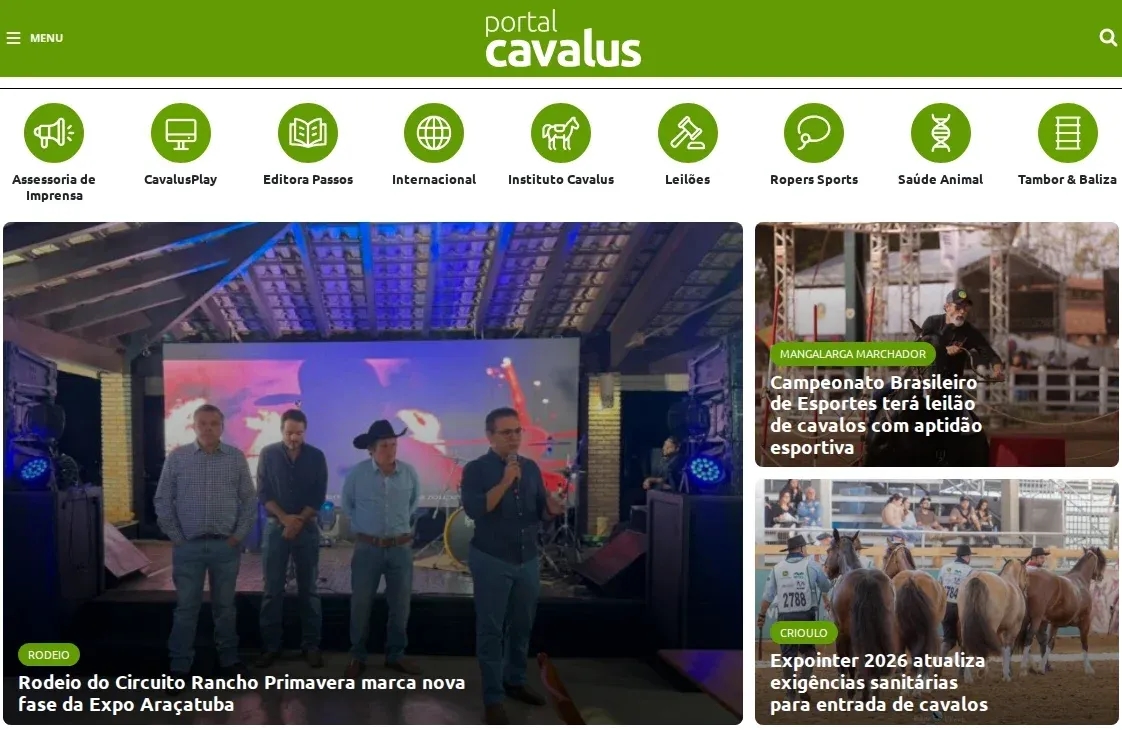
- Client
- Grupo Cavalus
- Sector
- Media · Equestrian news portal
- Deliverables
- Full rebuild, archive migration, advertising, infrastructure
- Duration
- About 5 years, and counting
- Stack
- WordPress · Custom theme · Dedicated VPS + caching · Cloudflare (CDN + security)
The project
Brazil's biggest equestrian portal, from code to server.
More than 13,000 articles published. An archive that starts in 2009. A library with over 35,000 media files. And a site that couldn't go down, couldn't lose a single indexed link, couldn't drop one position on Google. That was the size of the project when Cavalus gave us a shout. Today we look after the entire site, from code to server, every day.
Portal Cavalus is Brazil's biggest equestrian news portal, on the air since September 1, 2017. It's part of Grupo Cavalus, which also includes Editora Passos (publisher of magazines like Tambor & Baliza, Appaloosa, and Roper's Sports) and Agência Cavalus.
And when we say "portal", we mean a real portal. The newsroom publishes every day, several times a day. The content covers ten breeds, fifteen sport disciplines, animal health, auctions, culture, a photographers' gallery, and international coverage. In 2025, Cavalus itself counted 15 million visits.
A publication this size has one trait that changes everything from a technical standpoint: it has no pause button. Every day of content on the air is another day of authority built on Google, and that's what sustains the business.
The challenge
Replacing the foundation with the house still lived in.
Cavalus came to us through a referral, after seeing our work for another client. The request was to rebuild the portal.
Every site that publishes daily for years piles up layers. Each new need becomes a plugin, each plugin brings its own weight, and there comes a point when the structure that got you here isn't the one that will carry you forward. On top of that, the hosting no longer kept up with the portal's size. None of it is anyone's fault: it's what happens when a publication grows faster than the base it was built on.
And there lay the big challenge: rebuilding everything, better, without losing absolutely anything that already existed. It's like moving house with the whole family inside, and nobody losing the address.
In practice, that meant:
- Thousands of URLs already indexed on Google. A link that dies is an article that vanishes from search and a reader knocking on a closed door. Multiply that by thousands.
- An archive that starts in 2009, with digitized magazine issues that are part of the memory of the Brazilian equestrian market.
- A gigantic media library, now with over 35,000 files. Auction photos, show photos, championship photos. Not one could go missing.
- An already mature content architecture, with sections, breeds, and disciplines cross-referencing each other. It worked, and the newsroom already knew how to run it.
Our play
A custom theme, fewer moving parts.
The first decision was about what not to change. In a project this size, the question of whether it's time to switch platforms always comes up, and the answer was no: WordPress handled the volume, covered everything the portal needed and, above all, the newsroom already knew how to run it. Switching CMS would force an entire team to relearn their job mid-shift, without ever pausing publication. The gain would have to be enormous to make up for that — and it wasn't.
What needed to change wasn't the platform. It was the base built on top of it. That's why the central decision was building a custom WordPress theme for Cavalus, instead of stacking plugin on top of plugin.
The reason is simple to translate: every plugin that enters a site is one more part that has to load, update, and keep playing nicely with all the others. On a portal that publishes every day, that's a bill that only grows. When the code is yours, you control what loads, when it loads, and why.
And the difference showed up where it matters. The portal got much, much faster after the rebuild. Not "fast for a big site": genuinely fast. The page opens practically the moment you ask for it, and on a publication that lives off readers coming back several times a day, that changes the entire experience.
The content architecture we respected. The content types and taxonomies the newsroom already used were kept in the same pattern. What's new are the templates, purpose-built for each type of page. The people working inside didn't have to relearn how to publish. They just started publishing on a better site.
As for the migration itself, there's no magic secret: there's care. Every redirect checked, every image in place, every URL preserved. It was the quietest part of the project and the most important one, because its success is measured by what nobody noticed happening.
Advertising
The revenue engine is code too.
There's a part of this project that usually goes unmentioned in website case studies, but that's central at Cavalus: the advertising system.
The portal is a media outlet, and media outlets live off advertisers. The banners spread across the sections aren't decoration: they're one of the business's main revenue sources.
That's why we implemented an ad-management system on the portal, giving Cavalus control of that operation. At the time, it was the choice that made the most sense for their moment — and it's the one still running today.
It's worth spelling out what that means: when the site gets faster and more stable, it's not just the reader experience that improves. It's the ad inventory delivering better. Performance, on a portal, is a revenue line.
Ongoing operation
And after launch, we stayed.
A portal site isn't a delivery, it's an operation. That's why the second half of this case is the one that weighs most in the day-to-day: GritoWeb runs Portal Cavalus's infrastructure.
The portal runs on a dedicated, exclusive VPS for their WordPress. No sharing resources with third-party sites. The machine was sized to take heavy traffic, because on an equestrian portal the spike doesn't warn you: a national show publishes its results, a big auction opens, and traffic jumps from one hour to the next.
On top of that, here's what we keep running:
- A robust caching system. Instead of the server rebuilding the same page from scratch for every visitor, it serves the ready-made version. It's the difference between cooking to order and having the dish already coming out. On a portal with millions of visits, that's what holds the house up on spike days.
- Cloudflare handling security and CDN. The content is distributed across servers around the world, so the reader gets the page from the point closest to them. And traffic passes through a protection layer before reaching the server. Big sites attract attention you didn't ask for.
- Backup with redundancy, to cover even extreme failure scenarios. A backup without a copy isn't a backup, it's wishful thinking.
- Security monitoring and updates, which on a site with this much visibility is mandatory, not optional.
- Direct support to their team. The newsroom needed something, gave us a shout, we get it done. No tickets in a call-center queue.
Process
How we did it
The challenge: rebuilding without losing anything
Thousands of URLs indexed on Google, an archive starting in 2009, more than 35,000 media files, and a content architecture the newsroom already knew how to run. Nothing could be lost, and the portal couldn't stop publishing for a single day.
A custom theme, fewer moving parts
Instead of stacking plugin on top of plugin, we built a custom WordPress theme for Cavalus. When the code is yours, you control what loads, when it loads, and why. The portal got much faster, and the people publishing didn't have to relearn a thing.
Migration with no magic secret: with care
Every redirect checked, every image in place, every URL preserved. It was the quietest part of the project and the most important one, because its success is measured by what nobody noticed happening.
The revenue engine is code too
The banners spread across the sections are one of the portal's main revenue sources. We implemented an ad-management system that gives Cavalus control of that operation. And a faster site is ad inventory delivering better.
And after launch, we stayed
The portal runs on a dedicated, exclusive VPS, with a robust caching system, Cloudflare handling security and CDN, backup with redundancy, monitoring, and direct support to the newsroom. A portal site isn't a delivery, it's an operation.
Gallery
What we delivered
Results
What happened after
- 99,99%
- uptime. On a publication that publishes every day, staying on the air is the product
- 15 milhões
- visits in 2025, sustained by the infrastructure we manage
- 13 mil+
- articles rebuilt without losing a single indexed URL
- 35 mil+
- media files migrated without one going missing